
A little over two years ago, I decided to “surprise” my husband and came home with a chick order form from our local Agway. Thankfully, we had already discussed getting chickens, so I didn’t completely take him off guard, but he was perhaps a bit frightened by my enthusiasm. I tend to be the dreamer in our marriage – full of fantastical and whimsical ideas of what the farm could look like, what can go where, and just what we need to get there – whereas Harry grounds me with a nice dose of reality. I’m not saying that he doesn’t have his own dreams… only that his dreams usually possess more thought behind them than mine do. My spur-of-the-moment ideas often result in some form of trouble, and they do come together in the end, but bless him, Harry rarely tells me “no.”
On this particular day, despite my animated discussion of what chickens breeds we could adopt, Harry was on board. We had been doing research for weeks about what breeds would suit us and our climate. Here in the mountains of Vermont, it can get cold, and it stays cold for a majority of the year. The old-timers around here always used to say that Vermont gets eight months of winter and four months of bad sledding. They’re not entirely wrong. Because of this, we had decided to get New England bred birds, ones that we knew could withstand the cold. We opted not to heat our coop, as we tend to lose power frequently and didn’t want to subject chickens who are used to a heated coop to a night in the cold. Our coop is thoroughly insulated, however, and we use solar panels to run necessary accommodations for our girls. Despite the lack of heat, it’s a regular chicken hotel, I promise.
After consulting our chicken guides, we decided to order nine golden-laced Wyandottes and nine buff rocks. We thought that eighteen chickens was a great number to start out with, as we expected a few roosters and complications due to us being novice chicken owners. On pick up day, we didn’t exactly get what we ordered… Even though I arrived to pick up our birds at the agreed time, most of the chicks we ordered had already been sold. So, we ended up scraping together eighteen chickens, comprised of ten golden-laced Wyandottes, three silver-laced Wyandottes, three buff rocks, and two golden sex-links. Thankfully, all of these chickens are hardy birds, and as I reflect on them two years later, I couldn’t imagine bringing home any other combination. I had never understood the allure of being a “chicken mom” until our girls came home. Quickly, watching these little chicks jump around became our favorite pastime.
They started out in our basement until it was warm enough outside for them to go in the barn, and once they were large enough, they moved to the coop. We did cull our rooster, as I found out I was pregnant with our little boy and had a moment of panic about having an aggressive rooster around our newborn (which, honestly, sums up pregnancy brain very well. Did I believe that our rooster was somehow going to reach our second-floor nursery and snatch our child out of his bassinet? Yes, yes I did.).
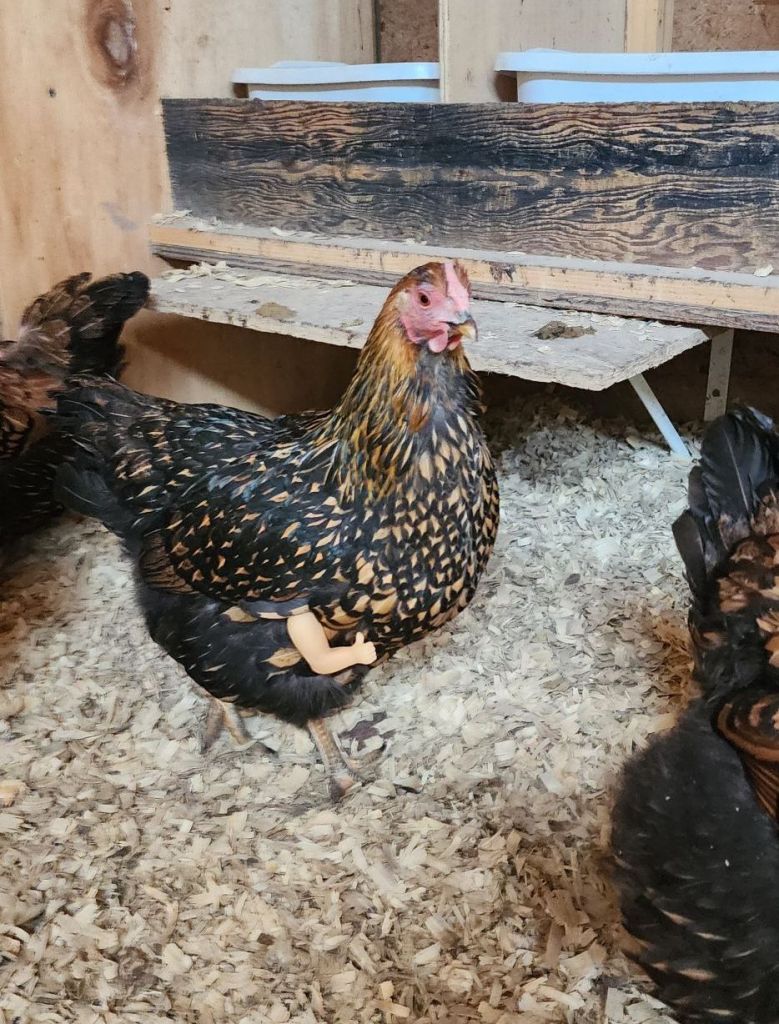
Anyway, from there, we moved forward with seventeen hens. We did end up discovering that hawks have an apparent preference for golden-laced Wyandottes, and after a few illnesses that we were thankfully able to contain, we sit now in the spring of 2025 with twelve birds. Our girls are just finishing a winter molt, and we are now getting an average of six eggs a night. In a world in which eggs are like gold, we’re okay with the haul that we get daily. These chickens do good work, and even though they are currently angry with me because they are locked in the run – again, hawks like Wyandottes and a certain bird of prey has been watching our chickens hungrily – I bring them more than enough snacks throughout the day to persuade them not to be too mad at me. In the future, I’d love to introduce them and highlight our experience with different ailments, but for now, I’ll leave you with the below photo that cost me enough snacks to feed a chicken army.
Until next time,
Jill
 The Glen Farm